
How Is Jumbo Glass Transported?
Jumbo glass—panels that exceed the dimensions of standard architectural glazing—is among the most challenging cargo in modern construction logistics. A single oversized sheet can span several meters, weigh hundreds of kilograms, and carry a value that makes any transit damage prohibitively expensive. Moving such glass from factory to façade requires purpose-built equipment, disciplined securement protocols, and route planning that begins long before the first strap is tightened. For manufacturers like Shandong Yaohua Glass Co., Ltd., mastering this discipline is not a back-office function—it is a core export capability.
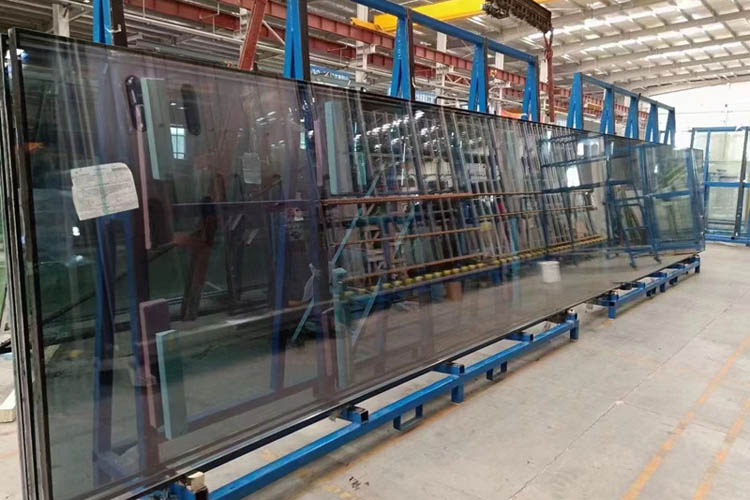
The A-frame foundation and controlled lean
Almost all jumbo glass transport begins with the A-frame rack, a triangular or L-shaped steel structure that holds glass sheets at a slight backward lean rather than flat or perfectly vertical. The recommended inclination is typically 3 to 6 degrees from vertical, with 5 to 6 degrees specifically advised for transportable racks and stillages. This modest tilt is not arbitrary: gravity presses the glass gently against the rack’s supporting surface, preventing it from leaning away and toppling during acceleration, braking, or cornering. For jumbo formats that exceed the capacity of a two-section A-frame, racks with a three-section configuration—a central A-frame joined to larger end sections—are used to distribute support across the full span of the sheets.
Securement on the rack follows a layered logic. Glass sheets are divided into groups resting against the inclined surfaces on either side, covered with protective material, and then bound with horizontal and vertical banding straps tensioned against anchors on the frame. Restrainers or outriggers are then tightened against the end edges to eliminate any longitudinal movement. The entire loaded rack is finally secured to the truck or trailer floor—historically through apertures in the A-frame base using double-headed nails, and today through modern twist-locks and heavy-duty fasteners.
Vehicles, containers and loading formats
On the road, jumbo glass moves either on a flatbed trailer carrying one or more A-frames, or in a purpose-built inloader, a semi-trailer whose side walls open to allow glass racks to be loaded laterally and supported along their full height. Inloaders can carry panels up to roughly 16 meters in length and loads approaching 20 tonnes, while keeping overall vehicle height within bridge-clearance limits. For export markets, glass up to approximately 12 meters can travel in standard 40-foot containers, with longer lengths requiring open-top containers or specialized racking systems.
Securement is where jumbo glass is won or lost
The difference between a clean delivery and a shattered panel often comes down to how the load is treated on the vehicle. Transport providers specializing in oversized architectural glass emphasize strategic load positioning for weight balance, protective edge guards and padding at every contact point, vibration-conscious securement, and careful tension control so that straps restrain the glass without introducing pressure stress. Unlike general freight, standard load straps are insufficient: the securement system must absorb road vibration while avoiding concentrated force on any single edge or face.
Route planning and the logistics chain
Because jumbo glass cannot be transshipped casually, logistics planning starts early. Industry guidance recommends involving logistics partners during the design and planning phase so that special transport registrations, route surveys, maneuvering space at the construction site, and sufficiently large level unloading zones are resolved before fabrication is complete. Unloading itself is a high-risk operation: equipment ranging from vacuum glass lifters rated for loads up to 10 tonnes and lengths of 18 meters to cranes and specialized grabs must be matched to the panel dimensions, and no restraint should be released until the load is confirmed stable.
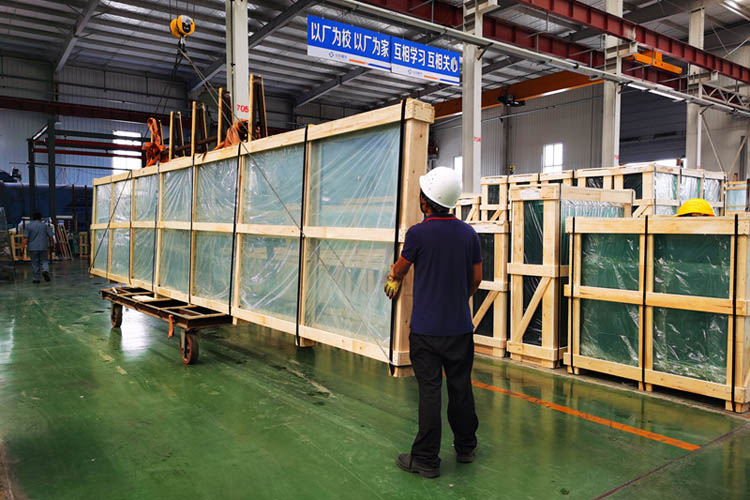
Shandong Yaohua Glass and export-scale jumbo capability
Shandong Yaohua Glass Co., Ltd. operates at the demanding end of this logistics chain. The company’s registered business scope explicitly includes large-scale object transport alongside glass manufacturing and import-export operations, giving it a formal operational basis for moving oversized cargo. Yaohua produces jumbo-size glass in thicknesses of 15 mm and 19 mm, including multi-layer laminated jumbo formats, and its export portfolio reaches more than 100 countries. The company holds ISO 9001, China’s 3C safety glass certification, EU standard certification, and Australian standard certification, and exports hundreds to over a thousand containers annually to markets spanning Southeast Asia, Australia, New Zealand, North America, and Africa.
For Yaohua's international customers, the practical implication is straightforward: jumbo glass transport is a system, not a single vehicle choice. It combines A-frame engineering, controlled inclination, specialized loading equipment, disciplined securement, and route coordination. A manufacturer that produces 19 mm jumbo laminated glass and holds large-object transport credentials is positioned to control that system from the tempering line to the port—or to the jobsite.

About Shandong Yaohua Glass Co., Ltd.
Founded in 1985 and headquartered in Jinan, Shandong Province, Shandong Yaohua Glass is a comprehensive glass deep-processing enterprise with three production bases and a product portfolio spanning LOW-E insulating glass, tempered glass, laminated glass, fire-resistant glass, curved glass, bullet-resistant glass, and 15 mm and 19 mm jumbo oversized and ultra-thick glass. The company has supplied glass to landmark projects including Beijing Red Star Macalline, Jinan Olympic Sports Center, Wanda Plaza, and Henglong Plaza, and serves international markets through an export network built over more than a decade.


