
Sliding Door Glass: Reshaping Modern Spaces with Transparent Aesthetics
In the evolving landscape of modern architecture and interior design, sliding door glass has transcended its utilitarian origins to become a defining element of spatial expression. Its inherent transparency and fluid motion dissolve the rigidity of traditional walls, allowing natural light to permeate deep into interiors while offering uninterrupted visual connections to the outdoors. Among the specialized manufacturers that have championed this transformation, The Sliding Door Company has distinguished itself through an unwavering commitment to glass innovation, material excellence, and design integrity. Since its founding, this enterprise has dedicated itself to exploring the full potential of glass as both a structural and aesthetic medium, setting benchmarks that influence the entire industry.
Glass as the Core: The Origin and Evolution of an Enterprise
The story of The Sliding Door Company begins in 2005, a time when the market for interior doors was dominated by heavy, space-consuming wooden swing doors and fragile mirrored panels that offered limited design flexibility. The founding team recognized a latent demand for a solution that could combine the lightness, safety, and modern appeal of glass with the space-saving functionality of sliding mechanisms. Their initial product—a simple tempered glass closet door—quickly revealed a broader opportunity. By focusing exclusively on glass-based sliding systems, the company was able to refine manufacturing processes, optimize glass selection, and develop proprietary hardware that would later become industry standards. Over the subsequent years, the enterprise expanded its footprint across North America and Asia, establishing showrooms, distribution networks, and collaborative design partnerships. Yet, despite this growth, the central philosophy remained unchanged: glass is not merely a filler material but a dynamic interface that shapes how people experience their environments. This ethos drives continuous research into glass strength, clarity, thermal performance, and acoustic properties, ensuring that every product reflects a deep mastery of glass science.
The Safety Bedrock of Glass: Synergy of Tempered and Laminated Glass
Safety stands as the non-negotiable foundation for any sliding door glass application. Modern building codes and consumer expectations demand that large glass panels withstand accidental impacts, thermal stresses, and even attempted forced entry. The industry has responded with two complementary glass technologies: tempered glass and laminated glass. Tempered glass undergoes a rigorous thermal tempering process, where it is heated to approximately 620 degrees Celsius and then rapidly cooled with high-pressure air. This treatment induces surface compression and interior tension, resulting in a strength four to five times greater than that of ordinary annealed glass. When breakage does occur, the stored energy causes the glass to disintegrate into small, cubical fragments with dull edges, virtually eliminating the risk of serious lacerations. This characteristic makes tempered glass the default choice for interior sliding doors, shower enclosures, and glass railings.
Laminated glass adds a second layer of protection by sandwiching a tough polyvinyl butyral (PVB) interlayer between two or more glass plies. The PVB film, typically 0.38 to 1.52 millimeters thick, bonds tenaciously to the glass surfaces, so that even under severe impact, broken shards remain adhered to the interlayer rather than scattering dangerously. This post-breakage integrity is crucial for overhead applications or areas where human traffic is dense. Moreover, the PVB interlayer provides inherent sound-damping qualities and blocks over 99% of harmful ultraviolet radiation, protecting interior furnishings from fading. Many premium sliding door systems now combine both technologies into laminated tempered glass units, achieving unparalleled robustness while preserving optical clarity.

Performance Optimization of Glass: Low-E Coatings and Insulating Glass Technology
Beyond structural safety, the thermal performance of sliding door glass directly influences building energy efficiency and occupant comfort. Uncoated glass acts as a thermal weak point, allowing heat to escape in winter and penetrate in summer. Low-emissivity (Low-E) coatings address this problem by applying a microscopically thin, transparent metallic oxide layer to the glass surface. This coating reflects long-wave infrared radiation—the primary carrier of heat—while permitting visible light to pass through with minimal attenuation. In cold climates, Low-E glass reflects indoor heating back into the room, reducing reliance on furnaces; in warm climates, it reflects external solar heat outward, lowering air-conditioning loads. The exact performance is quantified by two key metrics: the solar heat gain coefficient (SHGC), which measures the fraction of incident solar radiation transmitted through the glass, and the visible light transmittance (VT), which indicates how much daylight reaches the interior. Designers can select from a range of Low-E formulations to achieve optimal SHGC/VT ratios for specific orientations and climate zones.
To further enhance thermal resistance, the industry has widely adopted insulating glass units (IGUs) comprising two or three glass panes separated by a sealed airspace, typically filled with argon or krypton gas. These inert gases have lower thermal conductivity than air, effectively lowering the overall U-value (heat transfer coefficient) to as low as 0.2 W/m²K in triple-glazed configurations. The edge seals of IGUs are critical; high-quality units use warm-edge spacers made of stainless steel or polymer composites to minimize condensation and thermal bridging. This combination of Low-E coatings and gas-filled cavities transforms sliding door glass from a thermal liability into an active contributor to sustainable building design, often helping projects achieve LEED or Passive House certification.
The Aesthetic Evolution of Glass: Ultra-Narrow Frames and Expansive Views
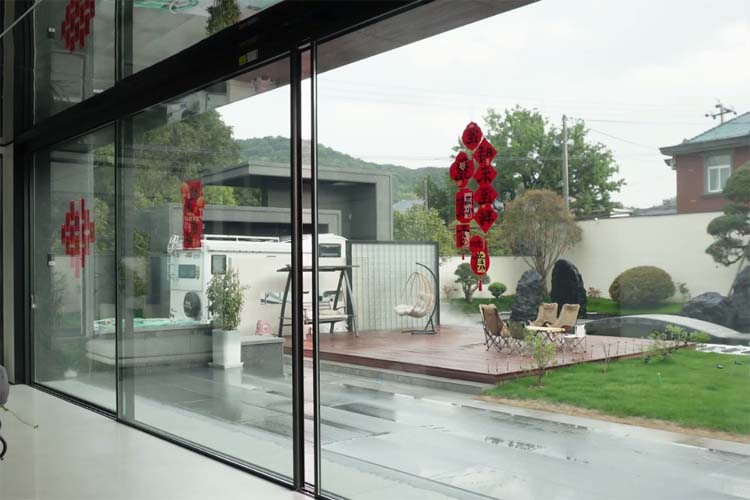
Contemporary architectural aesthetics increasingly gravitate toward minimalism, where visual clutter is reduced to emphasize pure forms and abundant daylight. This trend has driven a remarkable evolution in sliding door glass framing. Traditional sliding doors featured bulky aluminum or wood frames with visible widths exceeding 70 millimeters, which interrupted sightlines and diminished the perception of openness. Today’s cutting-edge systems achieve frame sightlines as narrow as 20 millimeters, effectively making the glass appear almost frameless. Such slender profiles are made possible through high-strength aluminum alloys and precision extrusion techniques that maintain structural rigidity while reducing material mass. The result is a near-seamless glass surface that transforms walls into dynamic, transparent planes.
Equally impressive is the trend toward oversized glass panels. Advanced manufacturing facilities now produce tempered glass panels up to 4.5 meters in height, allowing sliding doors to span floor-to-ceiling openings without horizontal mullions. When combined with multi-panel configurations, these expansive glass surfaces create panoramic vistas that merge interior living spaces with external landscapes—whether a private garden, a city skyline, or a coastal view. Some systems even incorporate curved or bent glass for unconventional architectural geometries, pushing the boundaries of what sliding door glass can achieve. Surface treatments such as acid etching, sandblasting, or digital ceramic printing add texture and privacy without sacrificing light transmission, offering designers a rich palette of visual effects that complement the inherent clarity of glass.
The Smart Evolution of Glass: Switchable and Functional Glass
The frontier of sliding door glass extends beyond passive performance into active, responsive functionality. Switchable glass, often referred to as smart glass or privacy glass, employs suspended particle devices (SPD) or polymer-dispersed liquid crystal (PDLC) technology. In its default state, the liquid crystal or particle suspension scatters light, creating an opaque, frosted appearance that ensures complete visual privacy. When a low-voltage electric current is applied, the particles align, allowing light to pass through unimpeded, rendering the glass clear. This switching occurs in milliseconds and consumes minimal energy, making it ideal for dynamic spaces such as conference rooms, healthcare facilities, luxury bathrooms, and retail fitting rooms. Some advanced systems offer gradient control, enabling partial transparency that preserves a sense of enclosure while maintaining visual connection.

Alongside switchable glass, other functional variants are gaining prominence. Ultra-clear low-iron glass reduces the natural greenish tint of standard float glass by lowering iron oxide content to below 0.01%, resulting in exceptional color fidelity and water-clear transparency—essential for art galleries and high-end showrooms. Acoustic laminated glass, which incorporates specialized sound-damping interlayers, can achieve weighted sound reduction indexes (Rw) of up to 40 decibels, effectively quieting spaces adjacent to noisy urban streets. Anti-reflective coated glass minimizes glare for digital signage or display applications, while self-cleaning glass with photocatalytic titanium dioxide coatings breaks down organic dirt under sunlight, reducing maintenance frequency. These innovations demonstrate that glass is no longer a static material but an intelligent interface that adapts to human needs and environmental conditions.
Reliable Support for Glass: Innovative Framing and Sliding Systems
The extraordinary performance of sliding door glass depends fundamentally on the quality of its supporting hardware and framing systems. Traditional sliding mechanisms relied on bottom-mounted trolleys rolling along floor tracks, which accumulated dust, created trip hazards, and often led to derailment under heavy loads. A pivotal breakthrough came in 2010 when The Sliding Door Company received a patent for a top-hung carriage system integrated within the vertical frame members. This design elevates the load-bearing wheels above the door leaf, eliminating floor tracks entirely while ensuring that the glass panel remains perfectly aligned throughout its travel. The concealed carriage incorporates sealed ball bearings and adjustable suspension bolts, allowing precise leveling and smooth gliding even for panels weighing over 200 kilograms.
Modern sliding systems also address noise and durability through advanced roller materials—such as nylon composite wheels with stainless steel races—that reduce friction and wear over decades of use. Anti-jump blocks and soft-close dampers are now standard features, preventing accidental dislodgement and cushioning the final few centimeters of travel for a serene closing experience. For multi-panel installations, synchronized sliding mechanisms allow multiple doors to stack compactly or open in sequence, maximizing clear openings up to 90% of the total wall width. Frame materials have evolved as well: thermally broken aluminum profiles prevent condensation on interior surfaces, while stainless steel and brass finishes offer corrosion resistance for coastal or humid environments. Every component—from rollers to handles to locking mechanisms—is engineered to complement the glass’s transparency, ensuring that the hardware remains unobtrusive yet utterly dependable.

The Green Promise of Glass: A Transparent Path to Sustainability
As global awareness of environmental stewardship intensifies, the sliding door glass industry is embracing transparency in both material composition and life-cycle impact. Leading manufacturers now publish Health Product Declarations (HPDs) and Environmental Product Declarations (EPDs), which disclose the chemical ingredients, raw material sourcing, manufacturing energy use, and end-of-life recyclability of their glass and framing systems. These documents empower architects and specifiers to make informed choices that align with green building rating systems like LEED v4, WELL, and BREEAM. Glass itself is infinitely recyclable without loss of quality, and many production facilities incorporate post-consumer cullet into their melt processes, reducing virgin material extraction and melting energy. Low-E coatings, though microscopically thin, are engineered to be durable and non-toxic, while PVB interlayers can be separated and recycled in specialized facilities.
Furthermore, the operational energy savings enabled by high-performance glass—through reduced heating, cooling, and lighting demands—far outweigh the embodied carbon of its production over a typical 30-year building life. This makes sliding door glass a strategic investment in decarbonization, contributing to net-zero energy targets. The industry is also exploring bio-based interlayers and low-carbon aluminum extrusions, pushing the frontier of sustainable innovation. Ultimately, the green promise of glass lies not only in its material properties but in its ability to connect occupants with nature, enhancing well-being and productivity—a qualitative benefit that is increasingly recognized in wellness-focused design frameworks.
Conclusion: Seeing the Future Through Glass
From its humble beginnings as a niche alternative to wooden doors, sliding door glass has matured into a versatile, high-performance building element that addresses safety, energy efficiency, aesthetics, intelligence, and sustainability in equal measure. The journey from simple tempered panels to switchable, ultra-wide, thermally optimized systems reflects a broader cultural shift toward openness, fluidity, and environmental consciousness. As manufacturing precision continues to advance and glass science unlocks new possibilities—including self-tinting, energy-generating photovoltaic glass, and even OLED-embedded transparent displays—the role of sliding door glass will only expand. It will continue to dissolve barriers, capture light, and frame the world around us, reminding us that the most profound architectural statements are often the clearest ones. Through the lens of glass, we not only see our surroundings with greater clarity but also envision a future where built spaces harmonize seamlessly with nature and human aspiration.


