

Round Tempered Glass
Shape and Size :Flat/ Curved or Custom size
Size: Min size: 300*150mm, Max size 3300*13500mm
Jumbo glass: Thckness 18*100mm, Max size 3300*13500mm
Certificate:CE,ISO9001,IGCC,US & Canada SGCC,AS/NZS,CCC
BS EN Heat Soaked Test Report Kuraray Sentry Glas Certificate
KS Certificate
Round tempered glass, also known as toughened glass, is a safety glass product thermally treated to achieve high compressive surface stress. It is approximately four to five times stronger than ordinary annealed glass of the same thickness. When broken, it shatters into small, relatively harmless granular fragments rather than dangerous sharp shards. This critical safety feature is mandated by building codes and product safety standards worldwide. Round tempered glass is precisioncut into circular shapes and widely used in furniture tabletops, architectural glazing, commercial displays, and various industrial applications. Its combination of strength, safety, and aesthetic versatility makes it a material of choice in modern design.
The technical specifications of round tempered glass are summarized in the table below.
Parameter | Specification |
Glass Types | Clear float, Ultra clear (lowiron), French green, Dark green, Euro grey, Dark grey, Ford blue, Dark blue, Euro bronze, Dark bronze, Pink, and custom colors |
Thickness Range | 3 mm – 19 mm |
Diameter Range | Custom sizes available; common diameters from 300 mm to 2,000 mm+ |
Dimensional Tolerance | ±0.5 mm for large sizes; ±0.1 mm for small sizes |
Thickness Tolerance | ±0.2 mm |
Edge Finishing | Flat polished, pencil polished, beveled, seamed, safety edge |

Round tempered glass finds extensive use across many industries. In furniture and interior design, it is applied to dining tables, coffee tables, cabinet doors, wardrobe panels, wine cabinets, bookcases, display shelves, office desk tops, and conference tables. In architecture and construction, the glass is used for bathroom partitions, interior room doors, corridor windows, glass guardrails, handrails, balconies, staircases, platforms, curtain walls, skylights, and storefront displays. Commercial and retail applications include jewelry showcases, watch displays, cosmetic counters, electronics display cabinets, shopping mall atriums, and escalator guardrails. In the appliance and electronics sector, round tempered glass is found in oven doors, microwave doors, induction cooker panels, smart home control panels, LED lighting covers, and lamp shades. It is also used in transportation for vehicle windows and high speed rail windows, as well as in specialty applications such as greenhouses, refrigerator shelves, escalator glass, industrial observation windows, and machine viewports.
The manufacturing process follows a strict sequence.
Cutting is performed first, where glass sheets are cut into circular shapes using CNC cutting, water jet cutting, or diamond blade cutting equipment. Edge processing follows, with edges finished through grinding and polishing to eliminate microcracks, which are stress concentration points, thereby enhancing edge strength and impact resistance. Edge options include polished, safety, beveled, smooth, 2.5D, pencil, and straight edges. If required, hole drilling and notching are carried out for mounting hardware, but all such work must be completed before tempering. Thermal tempering is then applied, where the glass is heated to approximately 620 to 680 degrees Celsius, above its annealing point but below its softening point, and then rapidly cooled with highpressure air jets. This rapid quenching locks the outer surfaces in compression while the interior remains in tension, creating the characteristic strength of tempered glass. Optionally, heat soak testing is performed by subjecting the glass to 290 degrees Celsius plus or minus 10 degrees for two hours, in accordance with EN 141791, to minimize the risk of nickel sulfide induced spontaneous breakage. Finally, quality inspection is conducted, including surface compression measurement using polarimetric methods, fragmentation testing, and visual inspection for optical quality.

Round tempered glass must comply with international safety and quality standards.
These include EN 121501 and EN 12600 for Europe, ANSI Z97.1 and CPSC 16 CFR 1201 and ASTM C1048 for the United States, AS/NZS 2208 for Australia and New Zealand, GB 15763.2 for China, and ISO 9001 as an international quality management system. Compliance with these standards ensures the glass meets required safety and performance criteria for different regional markets.
When selecting a round tempered glass manufacturer, you should evaluate several key aspects. Assess production capabilities such as factory scale, with at least 1000 square metres being preferable, and ensure the supplier has inhouse capabilities for cutting, drilling, edge polishing, tempering, and coating, along with an annual output that matches your volume requirements. Verify certifications and compliance, including ISO 9001, CE marking for the European Union, ANSI Z97.1 or EN 12150 for architectural use, CPSC compliance for North America, and thirdparty test reports that verify fragmentation safety and compressive strength. Examine technical expertise, particularly experience with custom shapes and sizes, the ability to produce your required thickness range from 3 to 19 millimetres, edge finishing options, and the capacity to meet dimensional tolerances of plus or minus 0.5 millimetres or better. Quality assurance should include surface compression of at least 10000 psi for fully tempered glass, fragmentation density of at least 40 pieces per 50 by 50 millimetre area, availability of heat soak testing for critical applications, and visual inspection standards for scratches, bubbles, and inclusions. Operational performance matters too, with an ontime delivery rate of at least 95 percent, responsive communication for requests and order updates, and export experience with proper packaging for international shipping. Finally, review the supplier’s track record, including years of operation, references from past clients especially in your industry, and evidence of their glass being used in recognizable landmark projects.
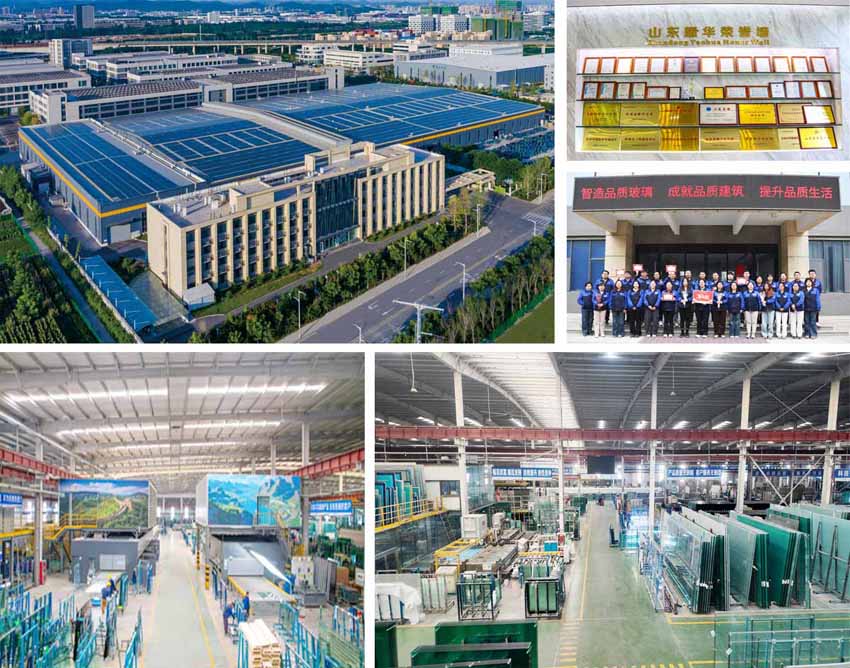
The manufacturer behind this product is Shandong Yaohua Glass Co., Ltd., located in Jinan, the capital of Shandong Province, and established in 1985. With over four decades of industry experience, the company has grown from manual glass cutting to globally advanced intelligent manufacturing, now operating a modern production facility of over 50000 square metres. Shandong Yaohua is a National HighTech Enterprise and has been honoured as one of China’s Top 30 Processed Glass Enterprises, a Shandong Province Specialized and Sophisticated Enterprise, a Shandong Province Manufacturing Single Champion, and a Shandong Province Technology Little Giant Enterprise. The company holds key certifications including ISO 9001, ISO 45001, China Compulsory Certification (3C) for safety glass, National Green Building Material Certification, Australian Standard Certification, Korean KS Certification, EU CE Certification, US SGCC Certification, and North American IGCC Certification. Its production equipment includes five domestic high standard flatbent tempering furnaces, with advanced tempering lines capable of processing glass from 3 to 19 millimetres in thickness. The company’s comprehensive glass processing capabilities span tempered glass, laminated glass, insulating glass, LOWE coated glass, fireresistant glass, and more. With customers in over 80 countries and regions and more than 1000 containers exported annually, Shandong Yaohua has supplied glass for numerous landmark projects worldwide, including Jinan Yaoqiang Airport, Beijing Intellectual Property Publishing House, Qingdao Hisense Financial Center, Busan Opera House in South Korea, PyeongChang Winter Olympics venues, Bahrain NECC New Convention Center, and Lusaka International Airport in Zambia.
Frequently asked questions about round tempered glass are listed below.
What is tempered glass?
Tempered glass (toughened glass) is safety glass strengthened by thermal treatment, creating compressive surface stress that increases strength four to five times and causes safe fragmentation into small granular pieces when broken.
What thicknesses are available for round tempered glass?
Typically from 3 to 19 millimetres. Common furniture applications use 6, 8, 10, and 12 millimetre thicknesses.
What edge finishes are available? Options include flat polished, flat ground, seamed, pencil ground, pencil polished, beveled, 2.5D edge, and safety edge.
Can round tempered glass be customized?
Yes. Diameter, thickness, edge finish, glass colour, and coatings such as antireflective, anti fingerprint, scratchresistant, and anti glare can all be customized to specification.
What is the difference between tempered and heat strengthened glass?
Tempered glass has higher surface compressive strength above 69 megapascals and fragments into small pieces, whereas heat strengthened glass has lower compression between 24 and 69 megapascals and breaks into larger pieces.
What is heat soak testing and why is it important?
Heat soak testing subjects the glass to 290 degrees Celsius plus or minus 10 degrees for two hours to minimise the risk of nickel sulphide induced spontaneous breakage. This reduces the probability of in service breakage to less than one in ten thousand panes.
What certifications should a round tempered glass supplier have?
Look for ISO 9001, EN 12150, ANSI Z97.1, CE marking, and relevant regional certifications such as 3C for China or AS/NZS 2208 for Australia.
How should round tempered glass be packaged for shipping?
Professional suppliers use PE film coating, kraft paper protection, sturdy wooden export crates with fumigation, and strapping for secure shipment.
Can holes be drilled in tempered glass?
Yes, but all drilling, cutting, and edge work must be completed before the tempering process. Tempered glass cannot be cut or drilled after tempering.
Is round tempered glass suitable for outdoor use?
Yes. It has excellent weather resistance and thermal stability, making it suitable for outdoor applications including patio tables, architectural glazing, and greenhouse panels.


